What to do in Los Cabos and how to plan your trip
Where the desert runs into the sea and the Pacific meets the Sea of Cortez. Two towns, thirty kilometres apart, with very different evenings — and a coastline where knowing which beach you can swim at matters.
- 4transport zones
- 83hotels
- 33 kmbetween the two towns
- 350days of sun a year
- UTC−7Mountain time

Everything you need to know about Los Cabos
Los Cabos is where the desert meets the sea, and it is not one place. San Jose del Cabo is the old town — a plaza, a church from 1730 and an art district — and Cabo San Lucas, thirty-three kilometres west, is the marina, the sportfishing fleet and the nightlife. The Tourist Corridor between them is where most of the big resorts sit, on cliffs above beaches that are often too rough to enter. At the very tip, El Arco marks Land’s End, where the Pacific meets the Sea of Cortez; from December to April grey and humpback whales pass close enough to watch from the shore, and further up the coast the whale sharks gather. Behind it all rises the Sierra de la Laguna, and south-east along the East Cape lies Cabo Pulmo, the only living coral reef in the Sea of Cortez.

Getting to Los Cabos
- Los Cabos Airport (SJD)Thirteen kilometres north of San Jose del Cabo and about forty-five minutes from Cabo San Lucas, with direct flights from across the US and Canada.
- The TranspeninsularHighway 1 runs the length of Baja. La Paz is two and a half hours north, Todos Santos about an hour.
- Cruise tendersCruise ships anchor off Cabo San Lucas and tender passengers into the marina, which is why the town is busiest in the middle of the day.
Beyond the beach
Three things this coast has that the Caribbean does not.


Good to know
- LanguageSpanish, with English spoken everywhere — this is the most US-facing resort area in Mexico.
- CurrencyMexican peso (MXN). Dollars are accepted almost everywhere and almost everywhere at a poor rate.
- Time zoneUTC−7, Mountain time, all year: Mexico dropped daylight saving in 2022, so the clocks no longer change. One hour behind Mexico City.
- Power127 V, 60 Hz, flat two-pin US-style plugs. Bring an adapter from the UK.
- WaterBottled water. This is desert — carry more than you think, especially on beach days.
- Emergencies911 nationwide. Both towns have private hospitals used to treating visitors.
Transfers from the airport to every zone of Los Cabos are a fixed price per vehicle, with the driver waiting at the exit. See availability.
What to see and do in Los Cabos
The full list, not a top three: what the destination’s tourist board puts first.
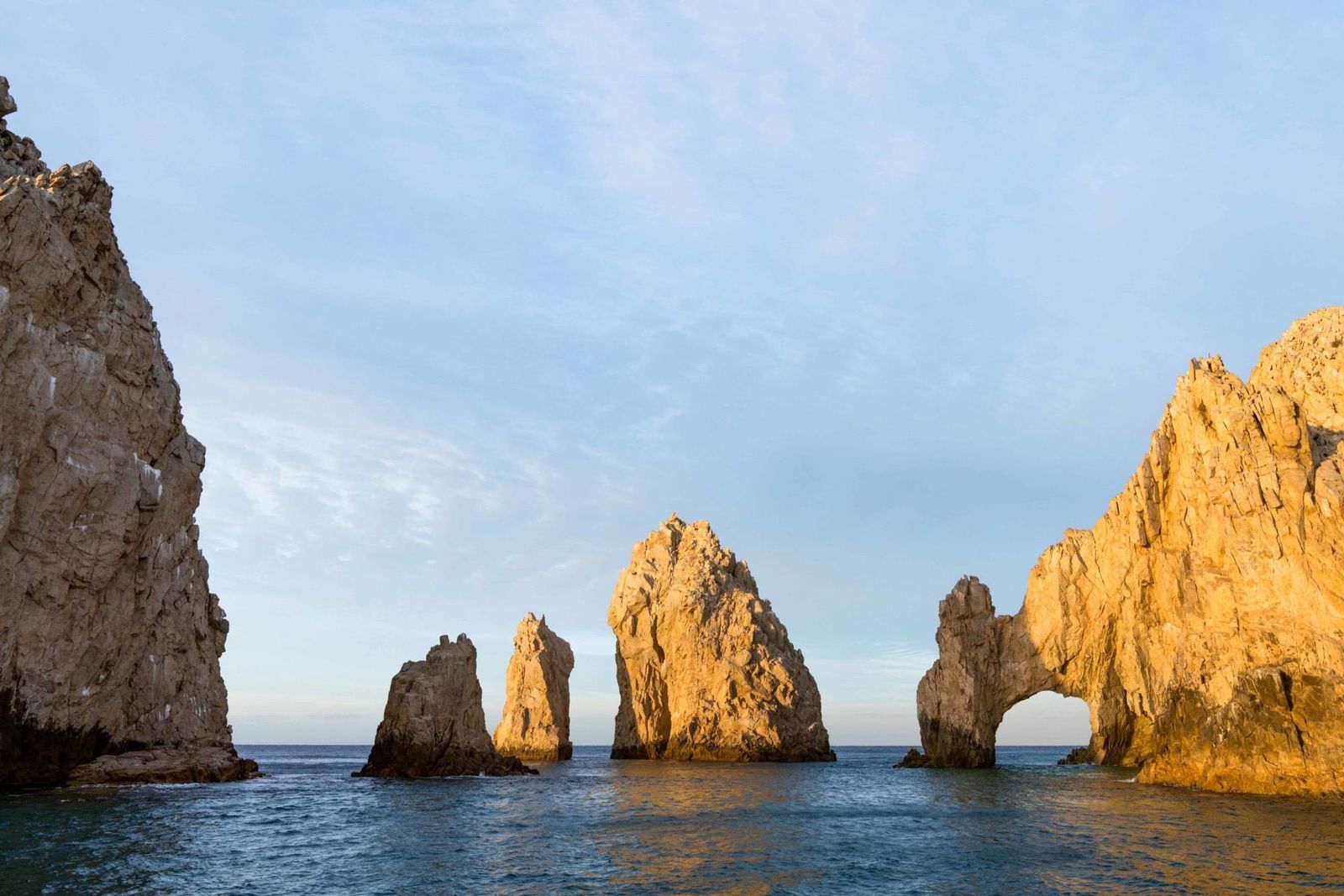
The rock arch where the Pacific meets the Sea of Cortez, reachable only by boat. Water taxis leave the marina all day; the sea lions on the rocks are permanent.
Lovers Beach, behind the arch, with the Pacific on one side and the Sea of Cortez on the other. Boat access only, and no swimming on the Pacific side.
The main swimming beach in Cabo San Lucas and the one with the beach clubs, the water sports and the crowd.
The two sheltered coves on the Tourist Corridor, both with reef close enough to snorkel from the sand.
Calm, shallow and family-friendly, on the San Jose side of the corridor.
The old town: a plaza, a church from 1730 and a gallery district that opens late every Thursday from November to June.
On the East Cape, the only living coral reef in the Sea of Cortez and a national park. Snorkel or dive it; the recovery here is a conservation success story.
Grey whales come down from the Arctic to calve and humpbacks pass on migration, December to April. In a good week you see blows from the beach.
Not in Cabo itself but in the shallow bay at La Paz, two and a half hours north, from roughly October to April.
What built the town: marlin and dorado out of both marinas, and a tournament calendar that fills Cabo San Lucas every October.
An hour up the Pacific side, a colonial town of galleries, surf breaks and mango orchards that feels a long way from the resorts.
The mountain range behind the coast, a biosphere reserve with walking trails, waterfalls and the only cloud forest in Baja.
Beaches of Los Cabos
Which ones you can swim on, which ones are for looking at, and why the difference is not obvious.
Cabo San Lucas’s main beach and the safest swimming in town: calm, shallow, lined with beach clubs and busy all day.
At the foot of El Arco, reachable only by water taxi. The Sea of Cortez side is safe to swim; the Pacific side behind it is not.
On the Corridor, both protected coves with reef and the best snorkelling on this coast. Blue Flag, with parking and facilities.
Sheltered by a point, shallow and calm, with pangas on the sand. The family beach of the Corridor.
The surf beach east of San Jose, with three breaks and a strong current. Surfboard, not swimwear.
When to visit Los Cabos
Four seasons for one destination. Choose yours by weather, crowds and price.
The high season: 20 to 28 °C, no rain, whales offshore and every hotel full. Book transfers and boats ahead.
Warm, dry and quieter, with the sea warming up. Arguably the best value of the year.
Hot, above 33 °C, and the hurricane window for the Pacific side. Prices are at their lowest for a reason.
The sea is at its warmest and the crowds have gone. Sportfishing tournaments fill Cabo San Lucas in October.
Getting around Los Cabos
One road links everything. What each way of using it costs.
Highway 1 links the airport, San Jose, the resorts and Cabo San Lucas. Everything is on it, and nothing is walkable between towns.
Fixed fares by zone, expensive by Mexican standards and the main way visitors get around. Agree the price before getting in.
Useful if you plan to reach Todos Santos, La Paz or the beaches off the main road. Parking in Cabo San Lucas is the annoying part.
Airport to resort at a fixed price per vehicle, and the only way to know what the journey costs before you land.
Areas of Los Cabos we serve
4 transport zones, each with its own page: hotels, times and fixed transfer prices from the airport.


Cabo San Lucas
Los Cabos · 33 km- Suburban $103
- Escalade $130
- Group van $160

San Jose del Cabo
Los Cabos · 10 km- Suburban $80
- Escalade $110
- Group van $149

Todos Santos
Los Cabos- Suburban $225
- Escalade $288
- Group van $363
La Paz
Los Cabos- Suburban $354
- Escalade $402
- Group van $567
Hotels in Los Cabos we pick up from
Fixed price to every hotel in the zone. If yours isn’t here, type it in the search box.
Cabo San Lucas
Los Cabos · 49 hotels- Free cancellation with Premium
- Flight monitoring
- Meet & greet
San Jose del Cabo
Los Cabos · 32 hotels- Free cancellation with Premium
- Flight monitoring
- Meet & greet
Tips from our local team in Los Cabos
What travellers ask us most, answered by the people who live here.
Most beaches here are not safe to swim
The Pacific side and much of the Corridor have heavy shore break and rip currents, and several have no lifeguard. Medano, Chileno, Santa Maria and Palmilla are the reliable ones.
The two towns are a different holiday
Cabo San Lucas for the marina, the boats and the noise. San Jose del Cabo for the plaza, the galleries and dinner that ends at eleven. Thirty-three kilometres and about forty minutes apart.
Timeshare sellers work the airport exit
The arrivals hall is lined with desks offering "transport". Walk past them to your booked driver; anyone stopping you before the exit is selling a presentation.
Baja runs on another clock
UTC−7 all year, one hour behind Mexico City and two behind Cancun. Flights and tours are quoted in local time, so set your phone and check it.
Whale season is a real season
Mid-December to early April. Outside it there are no whale trips, whatever the flyers on the marina say.
Book the water taxi at the marina
Trips to El Arco and Playa del Amor leave constantly from the quay at posted rates. It is cheaper than booking the same boat through a hotel desk.
Los Cabos travel guides
Practical, written by the team that drives the area every day.

The corridor: where the resorts are, and where the two good beaches are
Between San José del Cabo and Cabo San Lucas there are 33 kilometers of highway along a desert coastline, and almost every large resort in Los Cabos is …
2 read
Los Cabos is two towns, and they have nothing in common
At the tip of Baja California, where the Sea of Cortez meets the Pacific, there are two towns 33 kilometers apart with a corridor of resorts strung betw…
3 readGetting to Los Cabos from the airport
Fixed price per vehicle to every zone, driver at the exit with a name board. Full details on the airport page.
Transfer prices per zone in Los Cabos
| Transport zone | Journey time | Passenger van · up to 77 7 | Suburban5 5 | Escalade5 5 | Sprinter15 15 | See availability |
|---|---|---|---|---|---|---|
| Cabo San Lucas | 45 min | $112 | $103 | $130 | $160 | See availability |
| San Jose del Cabo | 20 min | $99 | $80 | $110 | $149 | See availability |
| Todos Santos | 75 min | $275 | $225 | $288 | $363 | See availability |
| La Paz | 2 h 30 min | $460 | $354 | $402 | $567 | See availability |
One way in USD per vehicle, taxes, tolls and luggage included. Return is the total for both legs. Journey times are estimates without traffic, worked out from distance and speed limits; those marked ≈ are approximate.