What to eat in Los Cabos and where to find it
In Los Cabos you eat looking at the ocean, because almost everything on the plate came out of it. The battered fish taco at breakfast, the chocolate clam cooked right on the sand, the aguachile that’s hotter than the menu lets on, the tuna tostada with the surf breaking a few steps away. And in recent years, something few people expect at the tip of a desert: organic farms supplying restaurants recognized by the Michelin Guide, and a wine list that comes from the other end of the peninsula. Here’s what to order, how to order it and where, with drive times from the airport and from your hotel, so you don’t spend your first night at the lobby restaurant.
Two seas, a desert and a fishing fleet
To understand the food here, look at the map. Los Cabos sits where Baja California Sur runs out: on one side the Sea of Cortez, calm and teeming with life; on the other the Pacific, cold and rough. Between them come tuna, mahi-mahi, marlin, snapper, sea bass, shrimp, octopus, pen shells and clams you’ll rarely see anywhere else in Mexico. Cabo San Lucas started out as a sportfishing port, and that fleet still heads out of the marina every morning.
Inland it’s cactus and mountains. It looks like nothing could grow there, but on the edge of San Jose del Cabo, in El Pescadero and in Todos Santos there are organic farms supplying the restaurants and a weekly growers’ market. That combination—fish caught today and vegetables picked next door—is what defines Los Cabos cooking.
There are two ways to eat in this destination, and you should try both. One is the stand and the taqueria: plastic plate, salsas on the counter, a soda in a glass bottle and the check paid in cash. The other is a long table under the trees or a terrace over the cliffs, with a reservation and a seasonal menu. What follows goes from the simplest to the most elaborate.
The fish taco, the way it’s ordered here
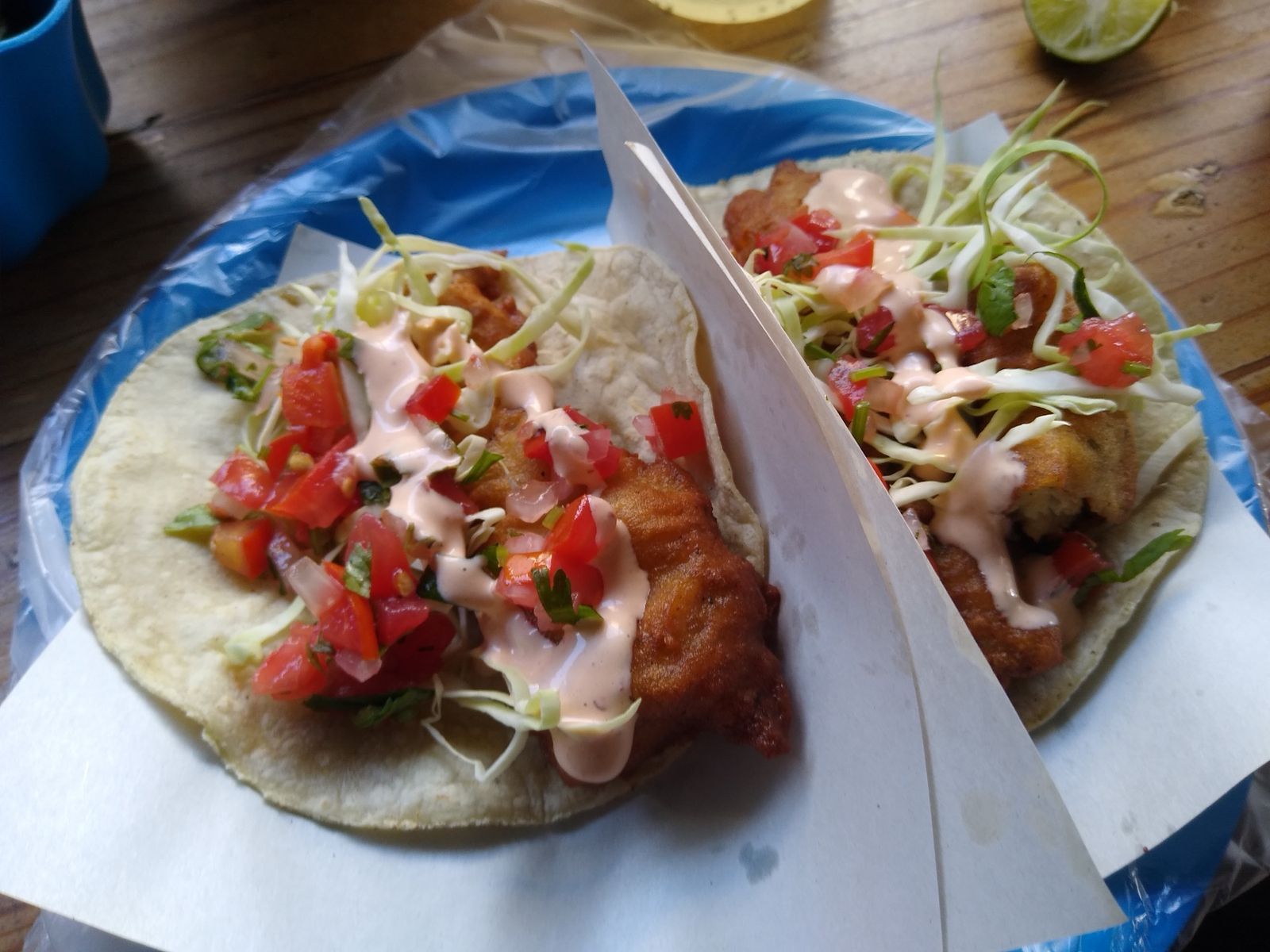
It’s the dish of Baja California, and in Los Cabos people eat it at any hour, although its natural time is morning through lunch. The classic has a strip of white fish dipped in a light batter and fried to order, on a corn or flour tortilla. On top go shredded cabbage and crema, and you finish it yourself at the salsa bar: pico de gallo, red salsa, green salsa, onion, lime and sometimes guacamole.
The unwritten rule: the fish comes out hot and crunchy, and you eat it right away. If it sits on the table or shows up soggy, that’s a bad sign. The other classic is the battered shrimp taco, dressed the same way. And one that’s very much of this peninsula is smoked marlin, cooked down with vegetables until it tastes something like a seafood version of shredded beef.
Two taquerias the Los Cabos tourism board recommends, and that people who live here know well:
Taquería Rossy, in San Jose del Cabo
More than thirty years of Baja-style fish tacos and ceviches in generous portions. A no-frills spot that fills up with locals at lunchtime.
Tacos Gardenias, in Cabo San Lucas
An old-school seafood favorite: crispy fish tacos, shrimp tacos and smoked marlin tacos, with an agua fresca, in an open-air room with no pretensions.
Pescadito Break, on Costa Azul beach
Steps from the surf in San Jose. Known for its tuna tostadas, tacos and raw seafood, with live music on weekends.
Tacos El Ahorcado, in downtown San Jose
Not seafood, but worth the stop: al pastor carved off the spit, with grilled pineapple and house salsas, eaten standing up on the street in the afternoon or late at night.
Chocolate clams: the one you won’t find anywhere else
If there’s one dish that belongs to Baja California Sur and nowhere else, it’s the chocolate clam, almeja chocolata in Spanish. The name has nothing to do with chocolate: it comes from the glossy dark-brown color of the shell. It’s a big, meaty clam harvested in the bays of the state, mostly on the Gulf side and in Magdalena Bay.
It’s served three ways, and it’s worth trying at least two:
Tatemada (charred)
The most traditional, born on the beaches of Loreto. The clams are laid out on the sand, covered with dry branches and set on fire. When the fire dies down, the meat has cooked in its own juice with a smoky flavor. Restaurants serve it with lime, salsa and sometimes a little butter.
Gratinada (baked)
Opened in its shell with melted cheese on top, sometimes with chile and other seafood. It’s the restaurant version, milder and the easiest to find on a menu.
Raw, “on the half shell”
Just opened, with lime, salsa and cucumber, sometimes mixed with octopus or shrimp. It’s the freshest and the one that tells you the most about the product: if the clam isn’t from today, you’ll know.
Chocolate clam fishing is regulated, with closed seasons by area. Off Loreto, for example, the federal government published a temporary ban for 2026 and 2027. That’s why not every restaurant has it year-round, and when the menu says it’s out, that’s a good sign: it means they respect the season.
Aguachile, ceviche and tostadas: the sea, raw
With the heat this place has most of the year, what people order most at the beach palapas is raw and cold. The rule here is simple: the closer to the water and the earlier in the day, the better.
Aguachile
Raw shrimp split butterfly-style and “cooked” in lime juice with chile, cucumber and red onion. It comes from Sinaloa, across the Sea of Cortez, and Los Cabos adopted it as its own. There’s green, chiltepin and black. The green is the hottest: ask before ordering if you don’t do spicy.
Ceviche
Chopped fish or shrimp cured in lime, with tomato, onion and cilantro, served on a tostada or with saltines. It’s the opener for almost any meal at the beach.
Tuna tostada
Slices of fresh tuna on a crunchy tostada with avocado and salsa. The tuna from these waters is among the best in the country, and in Los Cabos you’ll find it everywhere from the street stand to the chef’s table.
Pen shell (callo de hacha)
The muscle of a large mollusk with a long shell, served in thin slices with lime, cucumber and chile. Sweet and firm. It’s expensive and worth every peso.
Octopus
Grilled, in a seafood cocktail or, in the fall, in a version the tourism board highlights: pulpo al pastor, marinated and grilled like the spit-roasted pork, with charred pineapple.
A useful habit: eat raw seafood at lunch, not dinner, when the fish has been out of the water for hours.
Farm to table: the cooking that put Los Cabos in the Michelin Guide
The best plan for a lot of nights in Los Cabos is to leave the hotel and head toward the mountains. On the edge of San Jose del Cabo and along the Pacific coast toward Todos Santos there are organic farms with restaurants on site: what lands on your table was picked a few yards away that morning.
Flora Farms
The best-known organic farm in Los Cabos, in Animas Bajas, in the foothills outside San Jose. Its restaurant, Flora’s Field Kitchen, holds a Bib Gourmand and a Michelin Green Star, the one that recognizes sustainable practices. It also has a market with fruit, preserves and bread made on the farm.
Acre
A restaurant on a working property in San Jose del Cabo, with a seasonal menu that changes every week. It holds a Michelin Green Star and a recommendation from the guide.
Cocina de Campo
In El Pescadero, on the way to Todos Santos, on the organic fields of Agricole. Bib Gourmand from the Michelin Guide. It pairs well with a day in Todos Santos.
You go to these places with a reservation, especially from December through April, the high season. And you go by car: they’re outside town, partly on dirt roads, with no taxis waiting at the door when it’s time to leave. If you’re having dinner at a farm in the foothills, sort out your ride back before you go.
On high-season Saturdays, the Mercado Orgánico in San Jose del Cabo brings together growers from the region: produce, bread, cheese, prepared food and crafts. It makes a good late breakfast. Check its social media before you go, because the season and hours change from year to year.
Los Cabos restaurants in the Michelin Guide
The Michelin Guide arrived in Mexico in 2024, and Los Cabos made the first edition with one star and a long list of recommended restaurants. These are the ones the Los Cabos tourism board lists with a special distinction, checked on October 31, 2026:
| Restaurant | Where | Distinction |
|---|---|---|
| Cocina de Autor, at Grand Velas Los Cabos | Tourist Corridor | One Michelin star |
| Flora’s Field Kitchen, at Flora Farms | Animas Bajas, San Jose del Cabo | Bib Gourmand and Green Star |
| Acre | San Jose del Cabo | Green Star |
| Metate | Los Cabos | Bib Gourmand |
| Cocina de Campo | El Pescadero | Bib Gourmand |
Source: Los Cabos Tourism Board. The guide is updated every year; check the current edition before you book.
The Bib Gourmand is the distinction Michelin gives to good cooking at a reasonable price, and for a traveler it’s the most useful one of all. The Green Star doesn’t judge the plate but how it’s produced: its own garden, local ingredients, little waste.
On top of that, the guide recommends about twenty restaurants in the destination. In San Jose del Cabo they include Árbol, Carbón Cabrón, Lumbre, Nao, Omakai and Ruba’s Bakery. In Cabo San Lucas, Comal at Chileno Bay, Los Tres Gallos and Manta at The Cape hotel. And in Todos Santos, Benno, Dūm, Oystera and Tenoch. If you’re after a special dinner, that list is a good place to start.
Valle de Guadalupe wine, damiana and mezcal
The wine you’ll see on nearly every list in Los Cabos comes from Baja California, the state just to the north, and mostly from the Valle de Guadalupe, near Ensenada. It’s at the other end of the peninsula, more than 1,400 km away by road, but it’s the region that makes most of Mexico’s wine, and Baja cooking and its wines grew up together.
With the fish and seafood here, the valley’s whites work beautifully, especially sauvignon blanc and chenin blanc, along with the rosés. With farm cooking and steaks, reds made from nebbiolo or tempranillo, or the blends the valley’s wineries are known for. If you don’t know the labels, ask for the wine of the day: almost every serious restaurant pours something from the valley by the glass.
The region’s wine celebration is the Fiestas de la Vendimia, the harvest festival held in Ensenada and the Valle de Guadalupe in August.
Two more drinks that belong here:
Damiana
A wild plant from Baja California Sur used to make a sweet, herbal liqueur. The bottle shaped like a woman is the classic airport souvenir, and behind the bar it stands in for triple sec in a local margarita.
Mezcal and tequila
Neither is made in Baja, but the mezcal lists at Los Cabos restaurants are some of the most complete in the country. Ask for a small pour to taste and have them tell you which agave it’s from.
Where to eat based on where you’re staying
Everyone lands at Los Cabos International Airport, which is in San Jose del Cabo, at the north end of the Corridor. These are the drive times from there and what you’ll have nearby to eat:
| Area | From the airport | To eat nearby |
|---|---|---|
| San Jose del Cabo | 10 km · about 20 min | Historic center, taquerias, the Art District, farms in the foothills and Costa Azul |
| Tourist Corridor | 18 km · about 30 min | Resort restaurants, Cocina de Autor and drives out to both towns |
| Cabo San Lucas | about 45 min | The marina, seafood, downtown taquerias and the nightlife |
| Todos Santos and El Pescadero | about 75 min | Cocina de Campo, Michelin-listed restaurants and the town itself |
Drive times by highway, without traffic. In the afternoon, between the two towns, allow a little extra.
If you’re staying in San Jose del Cabo, you have the best mix of taquerias and restaurants within walking distance. On Thursday evenings in season, the Art Walk in the Art District fills the downtown streets and the restaurants around them: get there early or book.
If you’re staying on the Corridor, you’ll eat at the hotel a lot, and that’s fine, but get out at least two nights: one to San Jose and one to Cabo San Lucas. The highway is good and quick by day. At night, after a few glasses of wine, let someone else drive.
If you’re staying in Cabo San Lucas, the marina has a bit of everything, priced for every taste—and for every cruise ship. Walk two or three blocks inland and the prices drop while the tacos get better.
What to know before you sit down
Water
Don’t drink the tap water. At restaurants the ice and the water at the table are purified, and your hotel will leave you bottles.
Tipping
In Mexico it’s customary to leave 10% to 15% of the check. Many restaurants in tourist areas already include it: check the receipt before you add more.
Pesos or dollars
Almost everyone takes dollars, but the rate they give you won’t be in your favor. Pay in pesos or by card, and keep cash dollars for emergencies.
Spice
“Not spicy” in Los Cabos doesn’t always mean what it means back home. Ask for salsas on the side and test them with the tip of your taco.
Reservations
From December through April, and over Christmas and New Year’s above all, the good restaurants fill up. Book the places that matter to you before you fly.
With kids
Taquerias and beach palapas are the easy option: fast food, plenty of families and nobody minds the noise. The long farm dinners are for grown-ups.
Your arrival in Los Cabos, taken care of
Before the first taco comes the airport. We’ll be waiting at the terminal exit at Los Cabos International Airport with an eTransfers sign and your name, we track your flight in case it lands early or late, and we take you straight to your hotel in San Jose del Cabo, on the Corridor or in Cabo San Lucas. The price is per vehicle and locked in when you book, with no charges along the way.
If you’d like to stop at a supermarket on the way to pick up water and the basics, tell us when you book and we’ll make the stop. And if your plans include a day in Todos Santos and dinner in El Pescadero, we’ll drive you there too, so nobody has to take the highway back at night.
Transfers from Los Cabos Airport · Things to do in Los Cabos · San Jose del Cabo · Cabo San Lucas · Todos Santos
Traveler questions
What is the typical food of Los Cabos?
What is a chocolate clam?
Where are the best fish tacos in Los Cabos?
Are there Michelin-starred restaurants in Los Cabos?
Do I need reservations at Los Cabos restaurants?
Is the wine in Los Cabos local?
Can you drink the tap water in Los Cabos?
How much should I tip at a restaurant in Los Cabos?
How far is Todos Santos for a meal?
Sources
- Los Cabos Tourism Board, the Michelin Guide in Los Cabosvisitloscabos.travel · checked 2026-10-31
- Los Cabos Tourism Board, street eatsvisitloscabos.travel · checked 2026-10-31
- Los Cabos Tourism Board, fall dishesvisitloscabos.travel · checked 2026-10-31
- Diario Oficial de la Federación, temporary ban on chocolate clams off Loretosidof.segob.gob.mx · checked 2026-10-31
- Flora Farmsflora-farms.com · checked 2026-10-31


