The Puerto Morelos Cenote Route, one cenote at a time
If you’re looking for cenotes near Cancun, the answer starts about 25 km from the airport. At the Puerto Morelos junction, a paved road heads west for 35 km through the jungle to the town of Leona Vicario, and along it you’ll find every kind of cenote there is: open to the sky, half-covered by a rock dome, or deep inside a cavern. Some are full parks with zip lines and a buffet; others are a staircase, a life jacket and cold, clear water. We pick people up at the airport every day and they all ask the same thing: which one is worth it, how much it costs and how to get there without losing the whole day. Here’s what we confirmed on the official sites as of November 27, 2026, without the sales pitch and with the things nobody tells you before you leave the hotel.
What the Cenote Route is
The Ruta de los Cenotes—Spanish for “Cenote Route”—is a road, not a park. According to Quintana Roo’s Tourism Promotion Board, it’s about 35 km of paved road that runs inland from Puerto Morelos and ends in Leona Vicario, a small town in the same municipality. Along that stretch there are dozens of cenotes and several adventure parks open to visitors, each with its own entrance, its own hours and its own way of charging.
A cenote is what’s left when the roof of a limestone cavity caves in and exposes the fresh water flowing underneath. This route has all three types you’ll see advertised: open cenotes, like a big round pool ringed by jungle; semi-open ones, where part of the dome still stands and light pours in through the gaps; and cavern cenotes, where you walk down a staircase into an enclosed space. Each type calls for a different plan, and that’s the first thing to decide.
The route is in the middle of a cleanup of its rules. In November 2025 the Puerto Morelos municipal government, the state and federal agencies set up a working group to regularize what goes on along the road, and in May 2026 they presented progress on a local ecological zoning program that will regulate land use and the businesses there. For you, that means one practical thing: hours, prices and rules can change from one season to the next, so everything in this guide has a date on it.
The easiest cenotes to reach from Cancun and Playa
People who search for “cenotes in Cancun” are usually staying in the Hotel Zone and don’t want to spend half the day in a car. The Cenote Route solves that problem well: it sits halfway between Cancun and Playa del Carmen, and the junction where it starts is on the same Highway 307 you take from the airport to the Riviera Maya. These are the road distances to that junction:
| From | Distance to the start of the route | Drive time |
|---|---|---|
| Cancun International Airport | about 24 km (15 miles) | about 25 min |
| Downtown Cancun | about 36 km (22 miles) | about 35 min |
| Cancun Hotel Zone (Punta Cancun) | about 41 km (25 miles) | about 45 min |
| Downtown Playa del Carmen | about 32 km (20 miles) | about 30 min |
| Puerto Morelos town | about 3 km (2 miles) | about 5 min |
Distances to the Puerto Morelos junction on Highway 307, calculated with OSRM on November 27, 2026. They’re approximate: at rush hour, and heading back in the afternoon, allow more time.
Add the stretch of the route to the cenote you pick. The parks give their address by the kilometer marker on the road: Kin Ha lists itself at km 18.5, and Cenotes Zapote at km 19, plus a 5.5 km access road to the park entrance. From the Hotel Zone, a cenote at km 19 is a little over an hour’s drive; from the airport or from Playa del Carmen, quite a bit less.
Which cenotes to visit and what each one offers
These are the seven cenotes on the route that Quintana Roo’s Tourism Promotion Board describes, with what it says about each one and what the ones with their own website publish. We’ve sorted them by the kind of visit, not by kilometer:
Verde Lucero
Fully open, with jungle all around that turns the water a deep green. It has a zip line that crosses the cenote and drops you into the water, plus jumping platforms at 2, 4 and 7 meters. Its website says a life jacket is included for every activity and that it’s open daily from 9 a.m. to 5 p.m. It’s the most complete pick if you’re coming for the photo and the jump.
Siete Bocas
Semi-open, with seven openings in its rock ceiling that give it its name—“Seven Mouths.” There are several pools, you can jump into some chambers from the rocks, and divers follow passages underwater. It’s the most photogenic when the sun is high and shines straight down through the holes.
La Noria
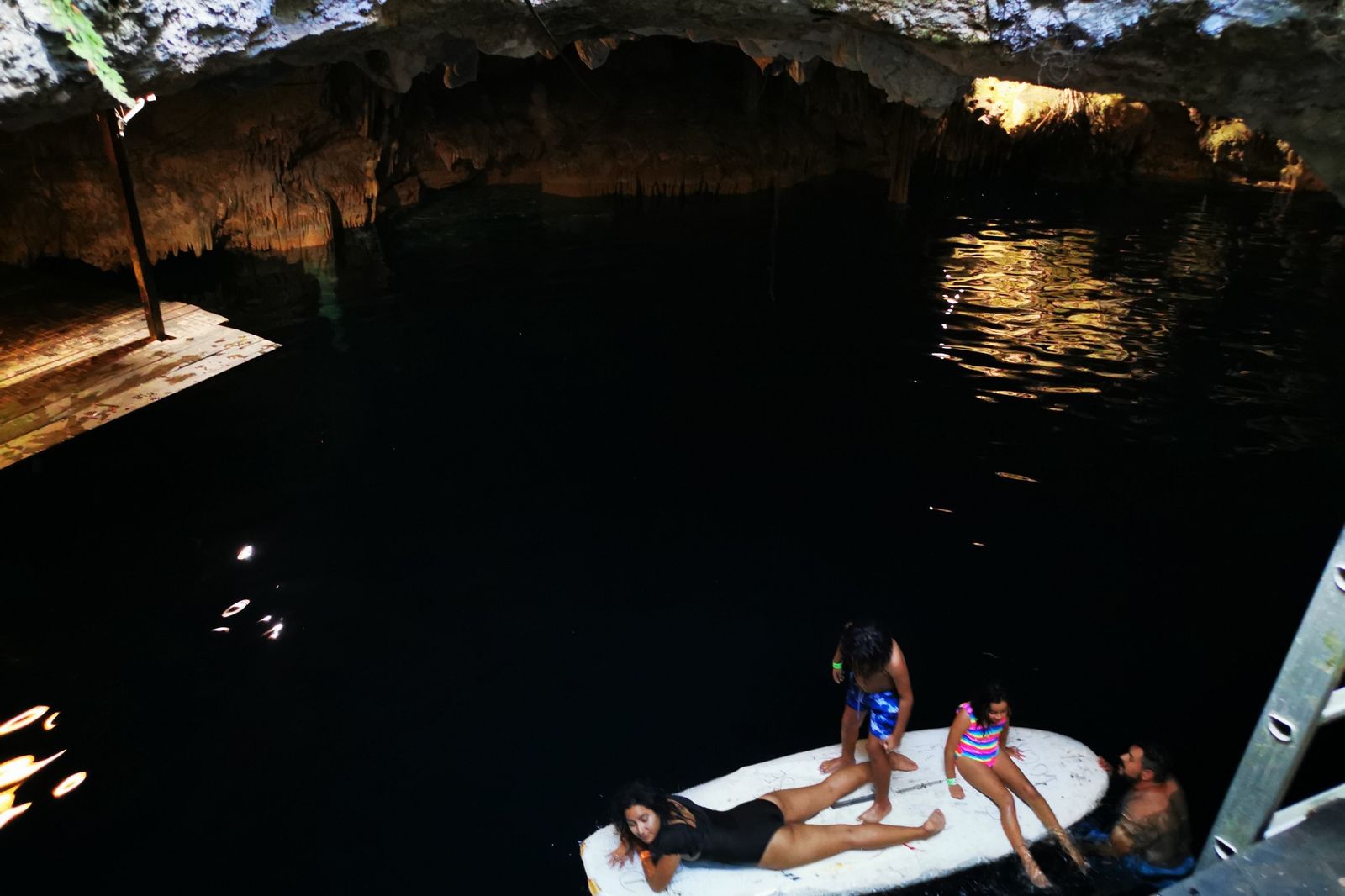
The calm option. A staircase takes you down into a cavern with a partly open roof and very clean blue water, and the best snorkeling is around the rock formations. There’s a rest area outside.
Kin Ha
A closed cenote where sunlight comes in through a single opening; its name means “sun and water” in Maya. There’s snorkeling, diving, zip lines and jumping platforms. Its website sells a package with two cenotes, one underground and one open, plus combos with ATVs and horseback riding.
Cenotes Zapote
Famous among divers for Hell’s Bells, bell-shaped formations about 30 meters (100 feet) down that only certified divers get to see. For everyone else, the park has four cenotes—two open and two underground—a jumping platform, a water zip line and a regional buffet.
Boca del Puma
More adventure park than cenote: zip lines over the treetops, ATV trails and cenotes with crystal-clear water. It works well for groups who want to fill the day with activities.
Las Mojarras
One of the largest open cenotes on the route, a wide circle of deep blue water. It has swimming, snorkeling, jumping platforms, zip lines and picnic areas, and the Tourism Promotion Board recommends it for families.
If you only have one day and you’re traveling with kids, go to Las Mojarras or Verde Lucero. If you want calm and clear water, La Noria. For adrenaline, Kin Ha or Boca del Puma. If you’re a certified diver, Zapote and Siete Bocas. And if you can’t swim, any of the open cenotes works with a life jacket, going in by the stairs and not off the platform.
Published hours and prices
Not every cenote on the route has its own website with rates. These are the prices published by the cenotes themselves, checked on November 27, 2026:
| Cenote | What’s included | Price per person |
|---|---|---|
| Verde Lucero | Entry with life jacket and parking; zip line and 2, 4 and 7 m jumps. Daily, 9:00–17:00 | Foreign adult MX$350; Mexican national with ID MX$250; local MX$200. Kids 0–9: MX$300, MX$200 and MX$150 |
| Kin Ha (Kin Ha & Blanca Flor package) | Two cenotes, one underground and one open | Adults and kids 3–9, MX$430; babies 0–2, MX$120 |
| Cenotes Zapote (Tour Zapote) | Four cenotes, regional buffet, jumping platform, water zip line, life jackets, showers and parking | Adults 12 and up, MX$1,108; kids 5–11, MX$804; ages 0–4, free |
Prices in Mexican pesos published on cenoteverdelucero.com, cenoteskinha.com and cenoteszapote.com. Zapote’s prices don’t include VAT. They change by season; confirm them when you book.
Read the fine print. Verde Lucero and Zapote charge by nationality, and the local or national rate only applies if you show valid official ID at the ticket window; without it you pay the general rate. Verde Lucero adds an 8% fee if you pay online by card or PayPal, and it takes cash at the front desk. Its last arrival time for online bookings is 3 p.m., two hours before closing.
For Siete Bocas, La Noria, Boca del Puma and Las Mojarras we couldn’t find current rates on an official site, so we won’t give you a number that could be out of date. Ask for the full price at the entrance before you pay: what’s included, whether the life jacket is extra, and whether there’s a separate charge for cameras, lockers or the zip line.
Getting there: car, taxi or train
The route works like most of the jungle in Quintana Roo: public transportation gets you to the start of the road, not to the door of each cenote. These are your real options, from the most freedom to the most comfort:
Rental car
The most flexible way to drive the route and see two or three cenotes in a day. From the airport, take Highway 307 south and turn right at the Puerto Morelos junction. Some parks sit well off the road—Zapote is 5.5 km down an access road—so take it slow and plan to be back before dark: this is a jungle road.
Taxi from Puerto Morelos
If you’re staying in town, a taxi gets you to a cenote in a few minutes. Agree on the fare before you get in and, above all, on the pickup time: don’t count on flagging down a free taxi on the road to get back.
Tren Maya
The Puerto Morelos station is inland, west of town, on the same road as the Cenote Route heading toward Leona Vicario. Taxis run from the station to downtown.
Organized tour
There are tours with transportation from hotels in Cancun and the Riviera Maya. Check which cenotes they include by name, how much time you actually get in the water and whether the entrance fee is already paid.
Our job is at both ends of the trip. We pick you up at the airport and take you straight to your hotel in Puerto Morelos, the best base for the route if you don’t want to drive an hour each way. If you’re splitting your vacation between Cancun and Puerto Morelos, or between Puerto Morelos and Playa del Carmen, we’ll also move you from one hotel to the other with all your luggage: the hotel-to-hotel transfer books the same way as the airport one.
How to plan the day
The route is best without rushing and with two cenotes of different types, one open and one cavern. A typical day, driving from the Cancun Hotel Zone, looks something like this:
| Time | What to do |
|---|---|
| 7:45 a.m. | Leave the hotel with breakfast done and your swimsuit on. |
| 8:45 a.m. | Puerto Morelos junction; gas and cash before you turn onto the route. |
| 9:00–11:30 a.m. | First cenote at opening time, before the tour groups arrive: an open one, with a jump or a zip line. |
| 11:30 a.m.–1:30 p.m. | Second cenote, cavern or semi-open, when the midday sun comes in through the openings. |
| 1:30–3:00 p.m. | Lunch at the park or on the square in Puerto Morelos. |
| 3:00–4:00 p.m. | The town beach, or an easy drive back before dark. |
Our suggested schedule, not the cenotes’. From Playa del Carmen or Puerto Morelos you can leave an hour later.
Two cenotes a day is the number that works. With three, the day turns into driving and changing rooms; with just one, you’re left wanting more. If you have small kids, an open cenote with good stairs and the afternoon on the Puerto Morelos beach, where the reef keeps the water calm, makes for a full day.
Water rules and how to protect the cenote
The water in a cenote is part of the aquifer the whole peninsula drinks from, and whatever is on your skin ends up there. The cenote regulations of the municipality of Solidaridad, home to Playa del Carmen, put it in writing, and in Puerto Morelos it’s simply good sense:
No tanning lotion or soap
The regulations ban tanning lotion, soap and any product that harms the ecosystem, except organic biodegradable products. The best move is to put nothing on before you get in the water; if you need it, make it biodegradable and apply it well ahead of time.
Shower before you go in
At cenotes that operate as swimming spots, you have to rinse off in the showers before getting in. Zapote lists showers among its facilities.
Life jacket
Cenotes run as swimming spots must have a trained lifeguard and enough life jackets. At Verde Lucero it’s included for every activity. Wear it even if you swim well: you float less in fresh water than in the ocean.
Don’t touch, don’t feed
Neither the rock formations nor the animals. Verde Lucero notes that its spider monkeys, iguanas and birds live wild and must not be fed.
No trash, no pets
Don’t leave trash in or around the cenote, and don’t bring pets, except service animals.
This isn’t theory. In March 2025, the state environment department and the Puerto Morelos municipal government pulled 640 kilos (about 1,400 pounds) of trash out of Cenote del Domo, in Leona Vicario, at the far end of this same route. And if you dive, remember that cavern diving is its own discipline: Zapote’s Hell’s Bells are for certified divers only.
What to pack
Swimsuit already on
It saves you the line at the changing room and gets you in the water sooner.
Water shoes
Wooden stairs and rock edges are slippery. Closed-toe sandals or old sneakers help on the trails too.
Towel and dry clothes
For the ride back, which you’ll appreciate once the AC kicks in.
Cash in pesos
For lockers, food, extras and any entrance that doesn’t take cards.
Official ID
If you’re Mexican or live in Quintana Roo, your ID is what gets you the national or local rate.
Bug spray, but afterward
The jungle has mosquitoes in the late afternoon. Put it on after you get out of the water, not before.
Waterproof phone pouch
With a lanyard. Light is low in the caverns, and photos come out better without the flash.
Your own snorkel mask
If you have one, bring it: at La Noria and Siete Bocas, snorkeling is half the visit.
What stays at the hotel: jewelry, expensive sunglasses and anything you don’t want to watch fall off a zip line. In dark fresh water, what sinks doesn’t come back up.
December and January on the route
December through April is the best weather of the year in Puerto Morelos, according to the Tourism Promotion Board, and December and January are also the busiest months on the whole coast. At the cenotes you’ll notice it in the morning: tour groups show up mid-morning, and on weekends local families join them. Getting there at opening time—9 a.m. at Verde Lucero—is the best decision you’ll make all day.
On December 24, 25 and 31 and January 1, many businesses change their hours. If your cenote day falls on one of those dates, message the cenote first through its official channels. And if you already have New Year’s Eve dinner planned in Cancun, save the route for January 2: fewer people and a quiet road.
From the airport to Puerto Morelos, taken care of
Before the route comes the airport. We wait for you at the terminal exit at Cancun Airport, track your flight in case it lands early or late, and in about 20 minutes you’re at your hotel in Puerto Morelos, 3 km from the first cenote. The price is per vehicle and locked in when you book: two people or eight pay the same in the same van.
If your base is Playa del Carmen, the transfer is just as direct and the route is half an hour north. Tell us how many of you there are and how many bags you’re bringing, and we’ll assign the right vehicle. If you can’t find your hotel in the search box, IAN will sort it out on WhatsApp.
Cancun Airport to Puerto Morelos transfers · Transfers to Playa del Carmen · Puerto Morelos guide · All about cenotes · Riviera Maya
Traveler questions
Are there cenotes near Cancun?
Where does the Cenote Route start?
How much does it cost to visit a cenote on the Cenote Route?
What are the cenotes’ hours?
Can I go without a car?
Do the cenotes take credit cards?
Can I wear sunscreen in a cenote?
Do I need to know how to swim?
Which cenote is best for kids?
Sources
- Quintana Roo Tourism Promotion Board, the Puerto Morelos Cenote Routemexicancaribbean.travel · checked 2026-11-27
- Quintana Roo Tourism Promotion Board, Puerto Morelos: Cenotes Routemexicancaribbean.travel · checked 2026-11-27
- Puerto Morelos municipal government, Cenote Route zoning (November 2025)puertomorelos.gob.mx · checked 2026-11-27
- Puerto Morelos municipal government, Cenote Route regularization (May 2026)puertomorelos.gob.mx · checked 2026-11-27
- Puerto Morelos municipal government and SEMA, Cenote del Domo cleanuppuertomorelos.gob.mx · checked 2026-11-27
- Municipality of Solidaridad, regulations for activities in cenotes, caverns and grottoesplayadelcarmen.gob.mx · checked 2026-11-27
- Cenote Verde Lucerocenoteverdelucero.com · checked 2026-11-27
- Cenotes Kin Hacenoteskinha.com · checked 2026-11-27
- Cenotes Zapote, Tour Zapotecenoteszapote.com · checked 2026-11-27