Whales in Los Cabos: the season, the species and the rules for seeing them
Every winter the sea off Cabo San Lucas and San Jose del Cabo fills with spouts. They belong to humpback whales that swim down from Alaska and Canada to mate, give birth and nurse their calves where the Sea of Cortez meets the Pacific. Mexico’s Environment Ministry has already published the 2026–2027 season: whale watching in Los Cabos opens on December 15, 2026, and closes on April 30, 2027. Here’s which whales you’ll see, how the boat trips work, what the federal rules say about distance and time, where boats can’t go, what you can see from shore and how to get from the airport to your hotel.
When the season starts and ends
In Mexico, whale season isn’t set by a hotel or a tour company. It’s set by the Environment Ministry (Semarnat) in a notice published every year in the Diario Oficial de la Federación, the federal government’s official gazette. The notice for 2026–2027 came out on October 30, 2026, and it lists, zone by zone, when boats may go out to watch whales and where they may not.
Los Cabos has three zones, and all three share the same dates:
| Zone in the official notice | 2026–2027 season | What’s closed |
|---|---|---|
| Cabo San Lucas Flora and Fauna Protection Area | December 15, 2026, to April 30, 2027 | 2 km around the Arch and a 1 km strip out to sea from Punta Ballenas |
| Cabo Pulmo National Park, Los Frailes–Cabo Pulmo and San Jose del Cabo | December 15, 2026, to April 30, 2027 | The coastal strip 3.5 km out to sea |
| El Sargento and La Ventana | December 15, 2026, to April 30, 2027 | Waters within 10 nautical miles of Jacques Cousteau Island (Cerralvo) |
Dates and zones from the Semarnat notice published in the Diario Oficial on October 30, 2026.
You’ll find other dates online. The Los Cabos Tourism Board’s diving and marine-life guide gives an official season of December 15 to April 15, and its tour pages say “December through April.” We go with the notice in the Diario Oficial, because that’s the one boats are bound by: for 2026–2027, whale watching closes on April 30.
The same Tourism Board guide places humpbacks in these waters from November 15. Before December 15 you might catch a spout from the beach, but permitted whale-watching trips start that day.
Which whales you’ll see in Los Cabos
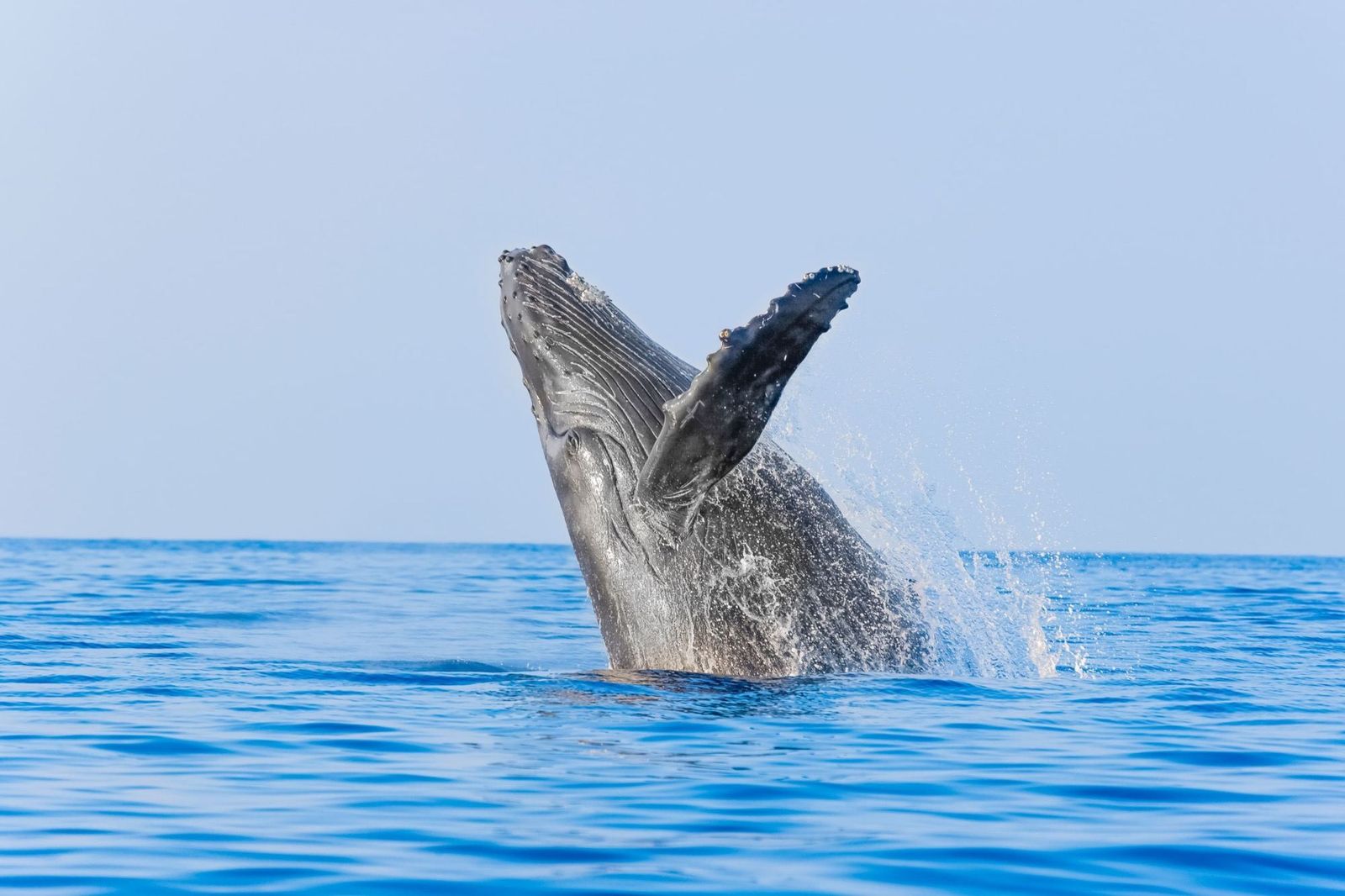
The star is the humpback whale. The Los Cabos Tourism Board puts it simply: humpbacks travel from the cold waters off Alaska and Canada to Baja California Sur to mate, have their calves and nurse them. It’s the whale that jumps. According to NOAA, the U.S. ocean agency, humpbacks spend a lot of time near the surface, breaching clear out of the water and slapping the sea with their pectoral fins and tails.
The Tourism Board’s marine-life guide says the most commonly seen whales here are humpbacks and grays, that blue whales, orcas and dolphins also show up, and that Bryde’s whales, fin whales and the occasional blue whale are not unusual offshore, where the seafloor drops quickly into deep water.
| Species | How often | How to tell it apart |
|---|---|---|
| Humpback whale | The most common of the season | Very long pectoral fins, breaches and tail slaps. Up to about 60 feet (18 m) long. |
| Gray whale | Seen here, but its winter home is the lagoons | Gray skin with pale patches and no dorsal fin. Up to about 49 feet (15 m). |
| Blue whale | Occasional, offshore | The largest animal on Earth. The rules make boats keep more distance. |
| Fin and Bryde’s whales | Now and then, in deep water | Long, fast rorquals with a clear dorsal fin. |
| Orcas and dolphins | Orcas occasionally; dolphins year-round | Dolphins often tag along on whale trips. |
Species from the Los Cabos Tourism Board’s diving and marine-life guide; sizes from NOAA.
A few humpback facts worth having in your head once you’re on the boat, all from NOAA: pregnancy lasts eleven months, calves are born 13 to 16 feet long, and the pattern on each whale’s tail is unique, so unique that scientists use it like a fingerprint to identify individual animals. The population that winters in Mexico is listed as threatened under the U.S. Endangered Species Act, and it breeds along Mexico’s Pacific coast and around the Revillagigedo Islands, passing the Baja California peninsula on the way.
The gray whale makes one of the longest trips of any mammal, about 10,000 miles round trip according to NOAA, and its calves are born between early January and mid-February in Mexico’s lagoons and bays. The big gray-whale lagoons are on the Pacific side, far north of Los Cabos: Ojo de Liebre, in the El Vizcaino Biosphere Reserve, and Magdalena Bay, each with its own season in the same official notice. They’re a separate trip. In Los Cabos, the plan is the humpback.
Why they come right here
Los Cabos sits at the tip of the peninsula, where the Pacific meets the Sea of Cortez. The Tourism Board calls it home to one of the richest marine ecosystems in the world, and explains why: deep underwater canyons lie very close to shore, letting open-ocean species come surprisingly close to land.
That geography is what makes it possible to see whales a few minutes from the marina, with Land’s End behind them, or even from a hotel terrace. It’s also why the sea off Cabo San Lucas has been protected for more than half a century.
According to the Los Cabos municipal tourism office, the Cabo San Lucas Flora and Fauna Protection Area was decreed on August 9, 1973, after marine geology studies on the peninsula supported by Jacques-Yves Cousteau. It protects the southern end of the Gulf of California and its species, with an emphasis on endemic ones. Farther north along the Sea of Cortez coast is Cabo Pulmo, declared a protected natural area on June 6, 1995: its coral reef is one of the few in the Eastern Pacific and the only one in the Gulf of California. Since 2005, Cabo Pulmo has been part of UNESCO’s World Heritage site “Islands and Protected Areas of the Gulf of California.”
How whale-watching trips work
The classic trip leaves from the Cabo San Lucas marina, which is where the Tourism Board sends you to book; you can also arrange one through your hotel’s concierge. There are two basic ways to go:
In a group, on a catamaran or sailboat
Big, stable boats with guides who explain what you’re seeing and talk about conservation. Trip length depends on the boat.
Private, on a panga
A small boat just for your group, leaving early morning, late morning or in the afternoon. The private trip the Tourism Board describes lasts about two and a half hours, with drinks and snacks included, and you can upgrade to a more comfortable boat.
On the San Jose del Cabo side there’s the marina at Puerto Los Cabos, in La Playita, a few minutes from downtown and opening straight onto the Sea of Cortez. If you’re staying in San Jose or at the eastern end of the Corridor, ask your hotel about trips from there before crossing the 33 km to Cabo San Lucas.
Before you pay for a trip, ask whoever is selling it three questions:
Does the boat have a whale-watching permit?
The rules require every authorized boat to display an identifying mark issued by the authorities. No mark, no permit.
How long is the trip, and how much of it is with the whales?
The limit with any one whale or group is 30 minutes. A well-run trip accounts for the ride out, the search and that viewing time.
How big is the boat?
It changes how close it can get: 60 meters for a boat under 10 meters long, 80 meters for anything larger.
The whale-watching rules: what the standard says
Every whale-watching trip in Mexico is governed by the official standard NOM-131-SEMARNAT-2010, published in the Diario Oficial on October 17, 2011. It isn’t fine print for the captain. It explains what you’ll see on board, why the boat stops where it stops and why nobody is going to put you in the water with a whale.
| Rule | What the standard says |
|---|---|
| Minimum distance, humpback and gray | 60 m for boats under 10 m long; 80 m for medium and large boats |
| Minimum distance, blue and fin | 100 m for small boats; 120 m for medium and large boats |
| Waiting distance | 240 m for any boat waiting its turn |
| Boats per whale | No more than 4 around the same whale or group |
| Time with each whale | No more than 30 minutes with the same whale or group |
| Speed | Under 5 knots (9 km/h) with whales nearby; 2 knots (4 km/h) on entering the viewing zone, and always slower than the slowest whale |
| Water under 10 m deep | Small boats only |
NOM-131-SEMARNAT-2010, sections 4.10 to 4.21 and Table 1.
The standard also says how a boat approaches: diagonally, from behind and to the side, moving parallel to the whale’s course. If the whale isn’t moving, the engine stays on in neutral; it’s only switched off to listen to whale song through a hydrophone. If the whale comes to the boat, the captain waits in neutral until it leaves, then pulls away slowly. And if a whale suddenly changes direction, stays down longer and longer or stops what it was doing, the boat backs off.
During whale watching, these are prohibited:
Getting in the water
Swimming, diving, fishing, water-skiing or parasailing near the whales.
Kayaks, paddleboards or Jet Skis
Nor canoes, paddle inflatables, banana boats, ultralights or helicopters. In the authorized zones, whale watching is done from permitted boats.
Separating a mother and calf
No getting between them, and no approaching whales that are mating or giving birth.
Chasing or scattering them
No harassing whales, cutting off their path or splitting up a group.
Feeding them
Or dumping trash, oil or fuel into the sea.
Using sonar to find them
The standard bans sonar and echo sounders for locating whales.
Bringing pets on board
Guide dogs excepted.
At the start of every trip, the operator has to brief you on how to behave while watching whales. Enforcement is the job of Profepa, Mexico’s federal environmental protection agency.
Where boats can’t go
The official season notice closes two zones inside the Cabo San Lucas protected area to whale watching, because of the sheer number of boats there:
The Arch
A 2 km zone around the Arch of Cabo San Lucas, in the northern part of the protected area, where the port is.
Punta Ballenas
A 1 km strip out to sea from Punta Ballenas, on the area’s eastern edge.
Farther north, in the Cabo Pulmo, Los Frailes and San Jose del Cabo zone, the coastal strip 3.5 km out to sea is closed. In restricted zones, only scientific work is allowed.
That explains something that surprises a lot of people: the boat leaves the marina, passes the Arch without stopping to look for whales and heads out to sea. It isn’t leaving the show behind. It’s getting out of the busiest part of the bay to watch where the rules allow it.
Watching whales from shore
The rules cover boats. Watching the sea from shore takes no permit, no boat and no ticket, and in Los Cabos it pays off: with the underwater canyons so close to the coast, whales pass within sight of many spots on land.
From your hotel
Many resorts in the Corridor and along the San Jose beach sit above the Sea of Cortez. A sea-view terrace and a morning coffee is the most comfortable way to spot spouts.
From the beach
At El Medano, Chileno, Santa Maria or Palmilla you can spend the day watching the horizon. They’re Sea of Cortez beaches; on the Pacific side the surf and currents are strong, and the water is for looking at, not swimming in.
What to look for
First the spout, a column of spray you’ll see before the whale. Then the back, the tail lifting before a dive and, with luck, the breach.
What to bring
Binoculars, a hat and sunscreen. In whale season the midday sun is strong even though it’s winter.
From shore there are no guaranteed distances and no whale on demand, but there’s no schedule and no seasickness either. For many travelers the ideal plan is both: a boat trip in the first days and the rest of the vacation with one eye on the sea.
Weather during whale season
Whale season lines up with the driest, mildest months in Los Cabos. These are the climate normals from Mexico’s National Weather Service for the San Jose del Cabo and Cabo San Lucas stations:
| Month | San Jose del Cabo (high / low) | Cabo San Lucas (high / low) | Rain in San Jose |
|---|---|---|---|
| December | 83 °F (28 °C) / 56 °F (13 °C) | 81 °F (27 °C) / 57 °F (14 °C) | 0.3 in (7 mm) |
| January | 82 °F (28 °C) / 53 °F (12 °C) | 80 °F (27 °C) / 55 °F (13 °C) | 0.2 in (5 mm) |
| February | 83 °F (28 °C) / 53 °F (12 °C) | 81 °F (27 °C) / 55 °F (13 °C) | 0.2 in (6 mm) |
| March | 85 °F (30 °C) / 55 °F (13 °C) | 83 °F (29 °C) / 57 °F (14 °C) | under 0.1 in (1 mm) |
| April | 87 °F (31 °C) / 58 °F (14 °C) | 86 °F (30 °C) / 60 °F (15 °C) | almost none |
National Weather Service (SMN) climate normals 1991–2020, rounded.
Days are beach weather. Before dawn and at sunset it cools down to the low to mid 50s °F (12 to 13 °C), and out on open water, with the boat’s wind, it feels cooler. For an early trip, bring a long-sleeve layer even if you’ll be in a swimsuit by noon.
A note on time: Baja California Sur runs on Pacific Zone time, two hours behind Cancun and one behind Mexico City. In winter that’s the same as Denver and one hour ahead of Los Angeles, so anyone flying in from the East Coast or the Midwest wakes up early without trying, which works in favor of a morning whale trip.
How to fit the whales into your trip
Whales don’t need a trip of their own. They fit into any week between December 15 and April 30, and in Los Cabos that window runs right through the busiest travel dates of the year.
At Christmas
The season opens ten days before Christmas Eve. On the morning of the 25th the whole destination is quiet, which makes it a good day to get on a boat. Everything else about December is in our guide to Christmas in Los Cabos.
At New Year’s
On January 1 the season is open and the boats go out, but that week the whole destination is full. Book now; the rest of the holiday is in New Year’s Eve in Los Cabos.
January to April
Once the holidays are over, the pressure on hotels and boats eases, and the season carries on in full. Easter week 2027 falls inside it.
To pick a base, think about where your boat leaves from. Cabo San Lucas has the marina within walking distance for anyone staying on El Medano or downtown. San Jose del Cabo is at the other end of the Corridor, 33 km from Cabo San Lucas, with the Puerto Los Cabos marina closer by. And from the Corridor, where most of the resorts are, either side is a short ride; we cover it in our Tourist Corridor guide.
After the boat, the Cabo San Lucas marina is a good place to eat: what to eat in Los Cabos has the fish tacos, the aguachile and the destination’s Michelin-recognized restaurants.
From the airport to your hotel in whale season
You’ll land at Los Cabos International Airport, north of San Jose del Cabo. Terminal 1 handles domestic flights and Terminal 2 international ones: if you’re flying in from the U.S. or Canada, you’ll come out of Terminal 2. December through April is high season here, and both terminals are busy.
| Destination | From the airport | Who it suits |
|---|---|---|
| San Jose del Cabo | 10 km · about 20 min | Travelers who want the historic downtown and the Puerto Los Cabos marina nearby. |
| Tourist Corridor | 18 km · about 30 min | Travelers who want a resort facing the Sea of Cortez and swimmable beaches. |
| Cabo San Lucas | 33 km · about 45 min | Travelers who want to walk from the hotel to the marina for their whale trip. |
| Todos Santos | about 75 min | Travelers looking for a quiet town on the Pacific side. |
Distances and times from our Los Cabos transfer pages.
After immigration and customs in Terminal 2, you’ll walk through a hallway of counters where people ask for your hotel and offer you a free ride. It’s a timeshare pitch. Keep walking: your driver is waiting outside the terminal exit.
We track your flight number
If your plane lands early or late, we move the pickup at no extra cost.
A locked price per vehicle
The price you see when you book is the price you pay, and it’s per vehicle, not per person.
If your dates change
Premium rates include free changes up to 12 hours before; with the Economy rate you get one change included if you let us know 24 hours ahead.
A stop at the grocery store
If you want to pick up water and basics on the way to your hotel, just tell us when you book.
Your Los Cabos arrival, sorted before you fly
The whales are out at sea. Your ride is better sorted from home. We meet you at Los Cabos International Airport with an eTransfers sign and your name, track your flight and take you straight to your hotel in San Jose del Cabo, the Corridor or Cabo San Lucas, at a per-vehicle price that’s locked in when you book.
Tell us how many of you are traveling, how many bags you’re bringing and the exact name of your hotel, and we’ll assign the right vehicle. If your whale trip leaves from the marina on the other side of the Corridor, we’ll take you there and pick you up when you’re back.
Los Cabos airport transfers · Things to do in Los Cabos · Cabo San Lucas · San Jose del Cabo
Traveler questions
When is whale season in Los Cabos?
Which whales can you see in Los Cabos?
Where do whale-watching boats leave from?
How long is a whale-watching trip?
How close can boats get to the whales?
Can you swim with whales in Los Cabos?
Why don’t boats look for whales near the Arch?
Can you see whales from the beach in Los Cabos?
How far is Cabo San Lucas from the airport?
Sources
- Semarnat, notice of the 2026–2027 whale-watching season (Diario Oficial, October 30, 2026)sidof.segob.gob.mx · checked 2026-11-22
- NOM-131-SEMARNAT-2010, guidelines and specifications for whale watching (Diario Oficial, October 17, 2011)sidof.segob.gob.mx · checked 2026-11-22
- Los Cabos Tourism Board, diving and marine-life guideassets.simpleviewinc.com · checked 2026-11-22
- Los Cabos Tourism Board, whale migration seasonvisitloscabos.travel · checked 2026-11-22
- Los Cabos Tourism Board, whale watchingvisitloscabos.travel · checked 2026-11-22
- Los Cabos Municipal Tourism Office, protected natural areasturismo.loscabos.gob.mx · checked 2026-11-22
- NOAA Fisheries, humpback whalefisheries.noaa.gov · checked 2026-11-22
- NOAA Fisheries, gray whalefisheries.noaa.gov · checked 2026-11-22
- Marina Puerto Los Cabospuertoloscabos.com · checked 2026-11-22
- National Weather Service (SMN), San Jose del Cabo climate normals 1991–2020smn.conagua.gob.mx · checked 2026-11-22
- National Weather Service (SMN), Cabo San Lucas climate normals 1991–2020smn.conagua.gob.mx · checked 2026-11-22
- Los Cabos Tourism Board, swimmable beaches and flagsvisitloscabos.travel · checked 2026-11-22
- Mexico’s Time Zones Law, article 3diputados.gob.mx · checked 2026-11-22


