Cenotes in Mexico: the water, rock, and rules behind the visit
A cenote is not a swimming pool with a nice backdrop. It is an opening into a groundwater system that supplies drinking water to most of a peninsula, and the thing you are swimming in is connected to the thing people drink. Once you know that, the rules about showering first and leaving the sunscreen in the car stop sounding like bureaucracy.
How one forms, and the myth about the meteorite
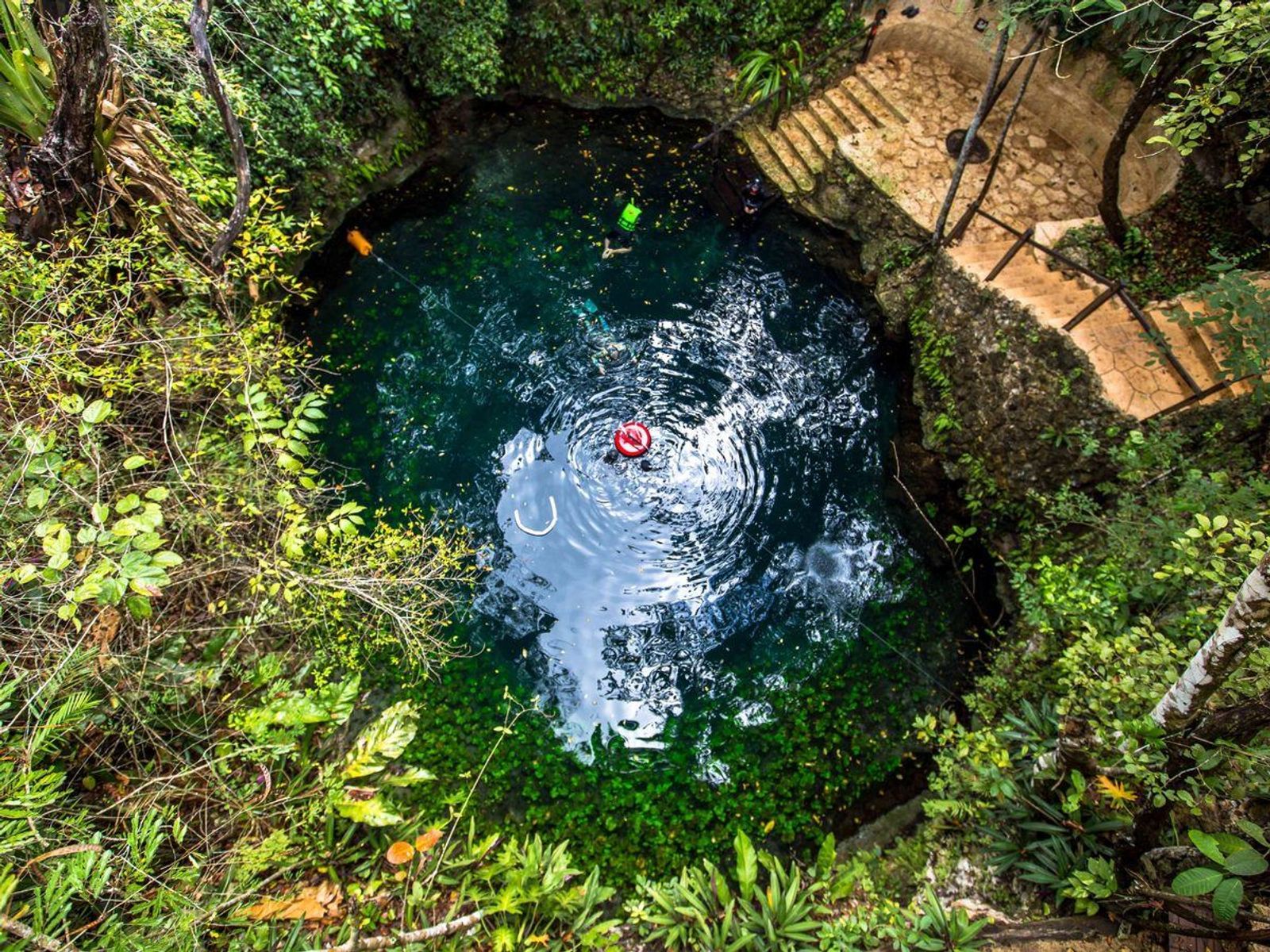
Rain moves down through fractures in soluble limestone. Over a very long time, the water dissolves the rock and opens cavities and passages underground. Where a cave roof opens or collapses through to the surface and reaches the water table, you get a cenote. There is no river in the Yucatán because all of it runs underneath.
The Chicxulub impact did shape the geology of northern Yucatán, and there is a ring of cenotes associated with its rim. What it did not do is punch thousands of individual swimming holes into the ground, which is the version that gets repeated. The cenotes you visit were dissolved out of the rock, slowly, by water.
Four kinds, and the label is not a safety rating
Open
Most of the roof is gone. A pond-like opening with direct sun, weather and vegetation around the rim. The easiest to swim in and the warmest.
Semi-open
Part of the roof remains, so the light moves through the day and the season. These are the ones that photograph well at a specific hour and look ordinary two hours later.
Cave
The water sits mostly under rock. Artificial lighting does not change the fact that access has to be controlled, with flotation and a guide.
Vertical access
Reached by a ladder or a staircase down a shaft. Exhilarating, and a genuine problem for anyone with limited mobility or a fear of heights.
Why the water deserves more care than a pool
The peninsula depends heavily on groundwater, and the cavities are connected to each other. The Mexican government describes the aquifer as highly vulnerable to contamination. Sunscreen, repellent, perfume and hair product all go into the same system, and the system does not have a filter.
Yucatán tourism authorities ask visitors to shower before getting in, particularly after using any product on the skin. Do it even when the bottle says biodegradable, because the rule at the door is the rule that applies and because “natural” is not a regulated word.
Choosing one without guessing
Managed access
Look for published opening hours, access rules, depth information and somebody responsible for the water. A pin on a map is not a visitor facility, and several of the ones circulating on social media are not.
The right activity
Swimming, introductory snorkelling, cavern tours and cave diving are four different things. Cave diving needs training and equipment well beyond an ordinary scuba certification, and people die when that distinction is blurred.
Mobility
Ask the number of steps, whether there is a handrail, and what the surface is like wet. Some cenotes are a comfortable staircase; others are a wooden ladder down a hole.
Children
Ask about the life jacket rule, the shallow area if there is one, and whether the entry is a ladder or a slope.
Where they are
Valladolid and the northern Yucatán routes have many managed cenotes and pair naturally with Chichén Itzá. The Riviera Maya has the long cave systems along the corridor between Playa del Carmen and Tulum. The Ruta de los Cenotes inland from Puerto Morelos is the one run largely by ejido communities, and the cheapest.
What there are not are cenotes in the Cancun Hotel Zone. Anything advertised as one is an hour or more away, and the article you read it in was describing Valladolid.
Four things not to do
Do not jump anywhere without an authorised platform
Clear water does not show you submerged rock, a change in depth or a swimmer underneath.
Do not touch the formations
Skin oil and pressure damage mineral surfaces that took a very long time to form and will not grow back in yours.
Do not go past the rope
A rope, a sign or a guide’s boundary is the edge of the visitor route, and beyond it there is no air space and no light.
Do not leave anything
Food, packaging, cigarette ends. It ends up in the water everyone downstream drinks.
Traveler questions
Is cenote water fresh?
Are there cenotes in Cancun’s Hotel Zone?
Can a confident swimmer skip the life jacket?
Is cave diving the same as scuba diving?
Can I put sunscreen on before swimming?
Sources
- National Commission of Natural Protected Areasconanp.gob.mx · checked 2026-09-25
- Yucatan Secretariat of Sustainable Developmentsds.yucatan.gob.mx · checked 2026-09-25
- Yucatan Secretariat of Sustainable Development, cenote dossiersds.yucatan.gob.mx · checked 2026-09-25
- Yucatan Secretariat of Tourism Developmentsefotur.yucatan.gob.mx · checked 2026-09-25
- Official Gazette, Yucatan Peninsula aquifer studysidof.segob.gob.mx · checked 2026-09-25